
Skip to content
← All articles

How to make a scent kit for a child who wanders (free printable)

A scent kit is a clean gauze pad that carries one person's scent, sealed in a jar or bag and labelled. Some search teams use scent-trained dogs and may ask for a clean scent item when someone is missing. Families of a child who wanders, or of an adult living with dementia, can make one at home in about five minutes. Store it somewhere cool and dark, replace it each year, and make sure responders know it exists. If someone goes missing, call 911 first. The free one page printable below has the steps and a label to fill in.

Last updated 25 November 2026. By Ashwin Chunchu, founder of StepSafe, which sells a GPS tracker for children who wander, so read the product parts with that in mind.

Illustration of a fridge with a plan held on its door by two coral magnets, three of five boxes ticked and a child's photo, beside a house inside a soft circle, on a torn paper card.

What a scent kit is, and why a search team may ask for one

Some police and sheriff’s offices use scent-trained dogs when a person is missing. A dog handler needs a starting scent that belongs to that one person. A worn shirt or a pillowcase is often handled by other people too.

A scent kit is collected ahead of time, in a clean way, and sealed. The International Association of Chiefs of Police (IACP) lists scent samples among the tools for families of people who may wander. It notes that kits can be bought, that some police departments give them out free, and that the sample can be handed to scent-tracking dogs when someone goes missing.[1]

The National Sheriffs’ Association describes agencies giving kits to families of people with dementia, autism and others at high risk of getting lost.[2] One city police department, for example, offers them for children with autism and adults with Alzheimer’s disease or other dementia.[4]

A scent kit is one extra item to have ready. It is not a search plan, and nobody can promise how it will be used. Responders decide what they need.

What you need to make a scent kit at home

Everything is sold at most pharmacies and grocery stores:

  • A sterile gauze pad, still in its sealed wrapper.
  • Disposable gloves, a new pair.
  • A clean glass jar with a tight lid, or a new zip-top freezer bag.
  • Tape and a pen, for the seal and the label.

Make one kit per person. If two children in the family wander, make two kits and label each one.

Before you buy anything, it is worth calling your local police non-emergency line. Some police and sheriff’s offices give out ready-made kits for free.[1],[4] If yours does, use theirs and follow their instructions.

How to make a scent kit, step by step

The aim is a pad that carries only this person’s scent. So keep everyone else’s hands off it.

  1. Wash your hands and put on new gloves. Do not touch the inside of the jar or bag.
  2. Open the gauze pad and hold it by one corner only.
  3. Collect the scent. Gently wipe the pad under the person’s arm about 10 times. One sheriff’s office gives the same step for its free kits.[3] If that is too much for them, let them hold the pad in their bare hands for a few minutes instead.
  4. Drop it straight in the jar or bag. Nobody else should touch it.
  5. Close it tightly and put tape across the lid or seal.
  6. Label it on the outside (see the next section).

For a child who dislikes being touched, make it part of a calm routine, such as after a bath. Show them the pad first and keep it short.

How to label and store the scent kit

Write the label before you need it. The printable has one to cut out. It asks for:

  • Name of the person whose scent it is.
  • Date collected.
  • Replace by, one year after the date collected.
  • Collected by, so responders know who to ask.
  • “Do not open. Hand to police or the search team unopened.”

Store it somewhere cool and dark, away from heat and direct sunlight.[3] A high kitchen cupboard or a hall closet shelf works. Choose a place every caregiver can reach in a hurry, and keep it there. Do not open it to check on it.

Replace the scent kit each year

You will see different figures for how long a sealed scent item keeps. Most come from the companies that make kits, not from independent studies.[2],[3] Rather than rely on any of them, keep it simple:

  • Make a new kit each year, on the “replace by” date.
  • Pick a date you will remember, such as a birthday or the start of the school year.
  • Make it sooner if the seal is ever opened, damaged or wet.
  • Make the new one first, then throw the old one away.

Add the replace by date to your phone calendar with a yearly reminder. It takes five minutes once a year.

Tell responders the scent kit exists

A kit nobody knows about is no use on the day. Make sure the right people can find it:

  • Write it on your plan. Add “scent kit: top shelf, hall closet” to your safety plan and the person’s emergency ID card.
  • Tell every caregiver. Grandparents, sitters, respite workers and care home staff should know where it is.
  • Ask your local police. Some departments keep a file on people who may wander, with a photo and key details. The IACP notes that some families have concerns about these registries, such as privacy and stigma.[1] Decide what you are comfortable sharing.

Our guide to telling neighbors and police about a child who wanders covers that conversation in more detail.

If they go missing: call 911 first

Call 911 first

Call 911 and check the nearest water at the same time. Do not stop to find the scent kit first.

The National Center for Missing & Exploited Children (NCMEC) advises calling 911 immediately if a child with autism goes missing, and searching the area around them, especially water, because time is of the essence.[5] Our free first 10 minutes checklist sets out the order on one page.

Then:

  1. Give responders a recent photo and what the person is wearing.
  2. Tell them a scent kit exists and where it is. A search team may ask for it.
  3. Hand it to the officer or dog handler unopened, and let them handle it.
  4. If there is no kit, tell them what the person wore or slept on most recently, and leave it untouched.

Making a scent kit for an adult living with dementia

The steps are the same for an adult. Wandering is common in dementia, and the same agencies that give out kits often offer them for people living with Alzheimer’s disease or other dementia.[2],[4]

  • Ask first. Explain what it is for in simple words, and ask if they are happy to help. Many people prefer to hold the pad themselves.
  • Pick a calm time of day. Late afternoon and evening can be harder for some people.[1]
  • Tell the care team. If they live in a care home or have home care, tell staff where the kit is kept.

Our guide to dementia wandering covers the rest of a plan for an adult.

The free printable scent kit instructions and label

Or download the one page PDF

Make the kit

  • New gloves on, hands washed
  • Sterile gauze pad held by one corner
  • Wiped under the arm about 10 times, or held in their bare hands for a few minutes
  • Dropped straight into a clean jar or new zip-top bag, sealed and taped
  • Label filled in: name, date collected, replace by, collected by

Store it and tell people

  • Kept somewhere cool and dark, away from heat and sunlight
  • Where it is kept written on our safety plan and ID card
  • Every caregiver told where it is
  • Yearly reminder set for the replace by date

If they go missing

  • Call 911 first, and check the nearest water at the same time
  • Give responders a recent photo and what they are wearing
  • Tell them a scent kit exists and where it is
  • Hand it over unopened
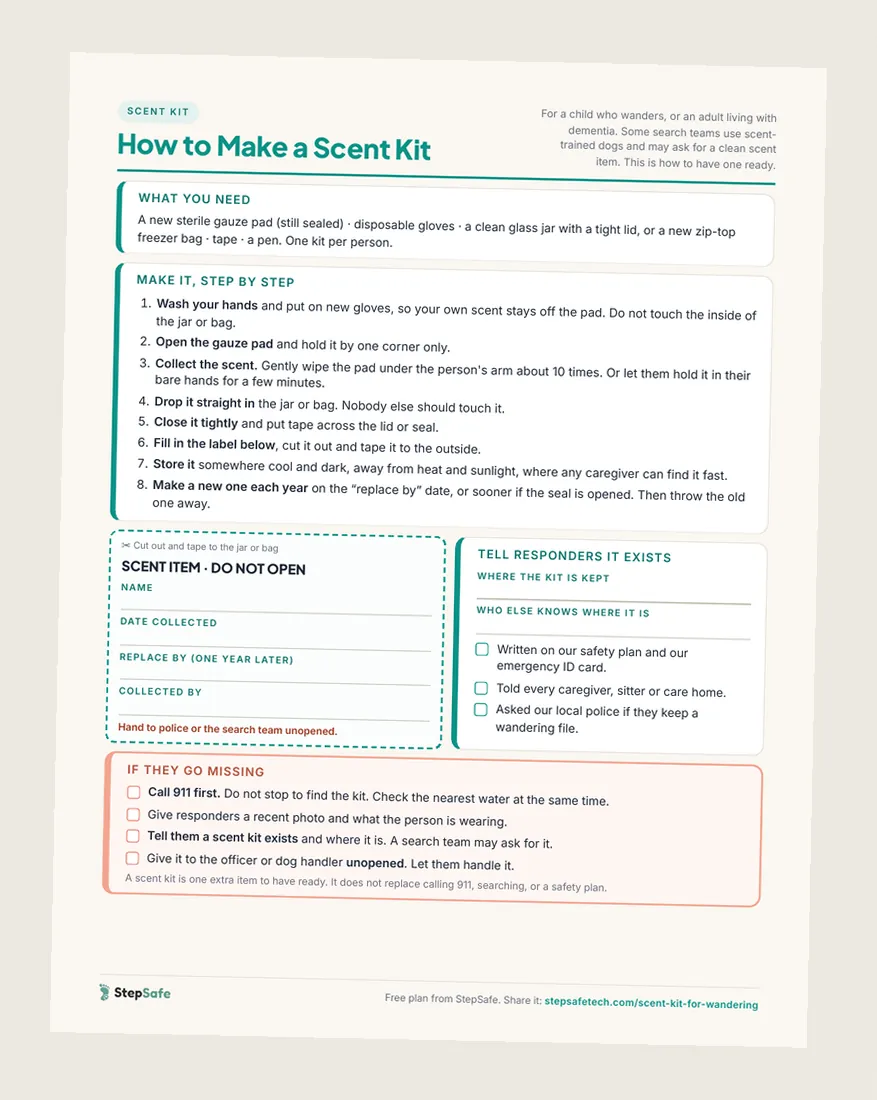
Preview of the free scent kit printable, with what you need, eight numbered steps to make the kit, a label to cut out with spaces for the name, date collected and replace by date, a box to note where the kit is kept and who knows, and a box for if they go missing, starting with calling 911 first.
The steps and a label to cut out, as a one page PDF. Print it, keep it with the kit, and note where the kit is kept.

Not sure which of these steps you already have in place? The free 2-minute Wandering Readiness Check gives you a score by area and a to-do list of free plans.

What this page is not

It is a planning guide based on the guidance linked below. It is not medical or legal advice. Instructions from police, search teams or your local emergency services always come first.

What we make

StepSafe is a GPS tracker for kids who wander. It is a location-awareness aid that does not replace supervision or a plan like the one above. Our free Wandering Readiness Check shows which parts of your plan are in place.

Looking for the tracker itself? See the StepSafe shop

Common questions

What is a scent kit for a child who wanders?

A scent kit is a sealed jar or bag holding a clean gauze pad that carries the child's own scent, with a label on the outside. If the child goes missing, some search teams use scent-trained dogs and may ask for a clean scent item. Families make one ahead of time so it is ready.

How do I make a scent kit at home?

Wash your hands and put on new gloves. Open a sterile gauze pad and hold it by one corner. Wipe it under the person's arm about 10 times, or let them hold it in their bare hands for a few minutes. Drop it straight into a clean glass jar or a new zip-top freezer bag, seal it, tape it, and label it with their name, the date and a replace by date.

How often should I replace a scent kit?

Published figures for how long a sealed scent item keeps vary, and most come from the companies that sell kits. A simple habit is to make a new one each year, for example on a birthday, and sooner if the seal is ever opened.

Where should I keep the scent kit?

Somewhere cool and dark, away from heat and direct sunlight, that every caregiver knows about. Write the place on your safety plan and the emergency ID card, so whoever is with the person can tell responders where it is.

What do I do first if my child goes missing?

Call 911 first. Do not stop to look for the scent kit. Check the nearest water at the same time. Then tell responders that a scent kit exists and where it is. A search team may ask for it. Hand it over unopened.

Can I make a scent kit for a parent with dementia?

Yes. The steps are the same. Explain what it is for in simple words and ask if they are happy to help. Some police and sheriff's offices give out free kits for people living with dementia or autism, so it is worth asking your local non-emergency line.

Free wandering safety resources

Whatever you decide about devices, preparation matters more. Every one of these is free, with no email required.

Sources

  1. International Association of Chiefs of Police, Project Home Safe: Promising Practices to Address Wandering of Individuals with Developmental Disabilities or Dementia (PDF, hosted by NCMEC)
  2. National Sheriffs' Association, How scent preservation is helping law enforcement find missing persons
  3. Orange County Sheriff's Office (Florida), Scent kits
  4. City of Kissimmee Police Department, Request a scent preservation kit
  5. National Center for Missing & Exploited Children, Supporting Children on the Autism Spectrum: Tips for Caregivers (PDF)

Free resources

Comments

Have a question, or something that worked for your family? Share it here. You only need a nickname.

No comments yet. Questions, experiences and tips from other parents are welcome.

Leave a comment

Every comment is read by a person before it appears. Please don't share your child's full name, school or address.

Shown with your comment. A first name or any nickname is fine.

Plain text. Links, emails and phone numbers are not allowed.0 / 2,000

All articles →

Are you a parent creator? Earn 15% when families you refer order. Join the partner program