Skip to content
← All articles

Elopement safety plan template for home (free printable)

An elopement safety plan for home is one page that says how and when your child leaves, what you have done to secure the doors, who is watching at the busy times of day, which neighbors know your child, where the nearest water is, and what every adult does first if your child goes missing. Writing it down means a sitter, a grandparent or a tired parent at 6 AM all follow the same plan. The seven steps below fill in the free template at the end, which you can print and keep on the fridge.

Last updated 17 November 2026. By Ashwin Chunchu, founder of StepSafe, which sells a GPS tracker for children who wander, so read the product parts with that in mind.

Illustration of a fridge with a plan held on its door by two coral magnets, three of five boxes ticked and a child's photo, beside a house inside a soft circle, on a torn paper card.

What is a home elopement safety plan?

A short written plan for a child who leaves home without telling anyone. It covers your child’s profile and photo, the times and exits they use, alarms and locks, who watches and who has been told, the nearest water and roads, and the emergency steps. Print the free template below, fill it in together, and give a copy to everyone who looks after your child.

Why an elopement safety plan for home matters

Elopement is common. In a large survey published in Pediatrics, 49% of parents of autistic children said their child had tried to elope at least once after age four, and 26% said their child had been missing long enough to cause concern.[1] The National Autism Association reports that accidental drowning accounts for 71% of lethal outcomes after wandering, followed by traffic injuries at 18%.[2]

The National Center for Missing & Exploited Children (NCMEC) notes that some children leave to get away from overwhelming sights and sounds, and others seek out things they are drawn to, such as water, trains, traffic or the woods.[3] Home is where a child knows every door, and where adults most often assume someone else is watching. A plan written in a calm moment is what everyone falls back on in a frightening one.

Step 1: Write down when and how your child leaves

Start with what you already know. Patterns are the most useful part of any elopement safety plan, because they tell every adult when to be most alert.

  • Times of day. Early mornings, the rush before school, evenings and bedtime are common for many families.
  • What comes first. A noise, a change of plan, a sibling’s friends arriving, or simply seeing an open door.
  • The way out. Which doors, windows, gates or the garage your child has used, and any they could reach.
  • Where they head. Water, a road, a neighbor’s trampoline, a train line, a favorite store. NCMEC suggests telling the people close to your child about these interests and places.[3]

Keep a short note on your phone for a few weeks each time your child tries to leave. Patterns often show up within days.

Step 2: Secure the doors, windows, gates and garage

The National Autism Association’s prevention checklist starts with securing the home, outdoor gates and the garage door, and suggests simple window and door alarms and baby monitors.[2]

  • Alarms or chimes on every outside door, so you hear a door open from anywhere in the house.
  • Extra locks or latches placed high, out of your child’s reach.
  • A way out in a fire. Every adult and older sibling must be able to open every lock quickly. Never lock a door in a way that blocks escape.
  • Gates and the garage. Latches out of reach, and a garage door kept closed.

Our guide to door alarms for autism goes through each kind of alarm and lock in detail. On the template, write down what is in place and when you last tested it.

Step 3: Decide who watches at the risky times

When several adults are home, each can assume another is watching. A home elopement safety plan names one person for each risky time of day.

  • Name the adult on watch. Mornings, the school run, dinner and bedtime each get a name, not “whoever is around”.
  • Say handovers out loud. “You have him now” and an answer back. If nobody answers, the handover has not happened.
  • Plan for visitors. The National Autism Association advises staying extra vigilant during transitions, parties, visits and times of noise or commotion.[2] Tell visitors before they arrive not to leave doors open.

Write the names on the template, and give sitters and relatives a copy along with our caregiver briefing card.

Step 4: Keep a current photo, and ID on your child

NCMEC recommends having a current photo and child ID ready for law enforcement.[3] The National Autism Association lists wearable identification among its prevention steps.[2]

  • A recent full length photo on every parent’s phone. Take a new one whenever haircuts or clothes change.
  • ID your child will keep on: a wristband, a shoe tag or a label sewn into clothing, with their first name and a parent’s mobile number. Keep your home address off anything a stranger can read.
  • How they communicate. NCMEC notes that more than a third of children on the autism spectrum who go missing may not speak.[3] Write down what your child does respond to.

Our free emergency ID card has space for all of this.

Step 5: Tell your neighbors and the people close to your child

NCMEC suggests letting neighbors, relatives, teachers, law enforcement and other trusted people know where your child may go, and introducing your child to your local law enforcement agency so officers know them and any support needs.[3] It also asks people to understand that a child may not speak, may not answer to their name, or may bolt if approached, so they should keep the child in sight from a safe distance without restraining them unless the child is in immediate danger.[3]

A short letter with a photo is the easiest way to start. Our letter to your neighbors is ready to fill in. Write the neighbors who know your child, and their phone numbers, on the template.

Step 6: Map the water and roads near your home

NCMEC advises being familiar with the bodies of water, highways and other landmarks near your child’s home and school, and reports that drowning most often happens close to where a child went missing and within minutes.[3],[4]

  • Walk or look at a map for half a mile around your home. Note pools, ponds, creeks, retention ponds and ditches.
  • Note the nearest busy road and any railway.
  • Write the closest water first on the template, so whoever is with your child knows where to run.

Our free map your water hazards worksheet walks you through it.

Step 7: The first minutes if your child leaves home

Do both at once

Call 911 and check the nearest water at the same time. One adult calls while another runs to the nearest water. Alone? Call on speaker as you go.

NCMEC’s advice is to call 911 immediately and search the surrounding area, especially bodies of water, because time is of the essence. Once 911 is called, you can also contact NCMEC at 1-800-THE-LOST (1-800-843-5678).[3] Then:

  1. Give responders the current photo and what your child is wearing.
  2. Tell them how your child communicates, and the places they are drawn to.
  3. Keep one adult at home in case your child comes back.

Our first 10 minutes checklist sets out the same order on one page.

Elopement risk points at home, and what to put in place

The moments below are where many families find the gaps. Use the table to fill in the “Our home” and “Who watches” parts of the template.

Common elopement risk points at home
When or whereWhat can go wrongWhat to put in place
Early morning, before adults are upA child can unlock a door while the house is asleepDoor alarms or chimes on outside doors; a baby monitor in the hallway; extra locks out of reach
Getting ready to leave the houseDoors open, adults busy, coats and bags everywhereOne named adult watches; your child stays in sight until everyone is in the car
Visitors and deliveriesThe front door is opened by someone who does not know the riskA note on the inside of the door; tell visitors before they arrive
Evenings and bedtime routinesAdults tired, attention split between childrenHandovers said out loud; alarms switched on before dinner, not at bedtime
Back yard and garageGates left open, a garage door that is easy to liftGate latches out of reach; garage door kept closed; an alarm on the gate
A new home or a visit to familyNew doors, new locks, water you have not checkedWalk the exits first; check the nearest water before you unpack

Free elopement safety plan template for home

Or download the one page PDF

About our child

  • Name, age, height and hair written down
  • How our child communicates, and whether they answer to their name
  • What upsets them and what calms them
  • Places and things they are drawn to
  • A current photo on every parent's phone, and ID on our child with a parent's mobile number

When and how our child leaves home

  • Times of day it happens most
  • What usually comes first
  • Doors, windows, gates and the garage they have used or could use

Our home

  • Door, window and gate alarms in place and tested
  • Extra locks out of our child's reach, and every adult can open them fast in a fire
  • Nearest water and nearest busy road written down

Who watches, and who we tell

  • An adult named for each risky time of day
  • Handovers said out loud
  • Neighbors who know our child, with their phone numbers
  • School, relatives and local police told

If our child leaves home

  • Call 911 and check the nearest water at the same time (alone: call on speaker as you go)
  • Give responders the photo, what our child is wearing, how they communicate and where they are drawn to
  • One adult stays at home; then call 1-800-THE-LOST (1-800-843-5678)
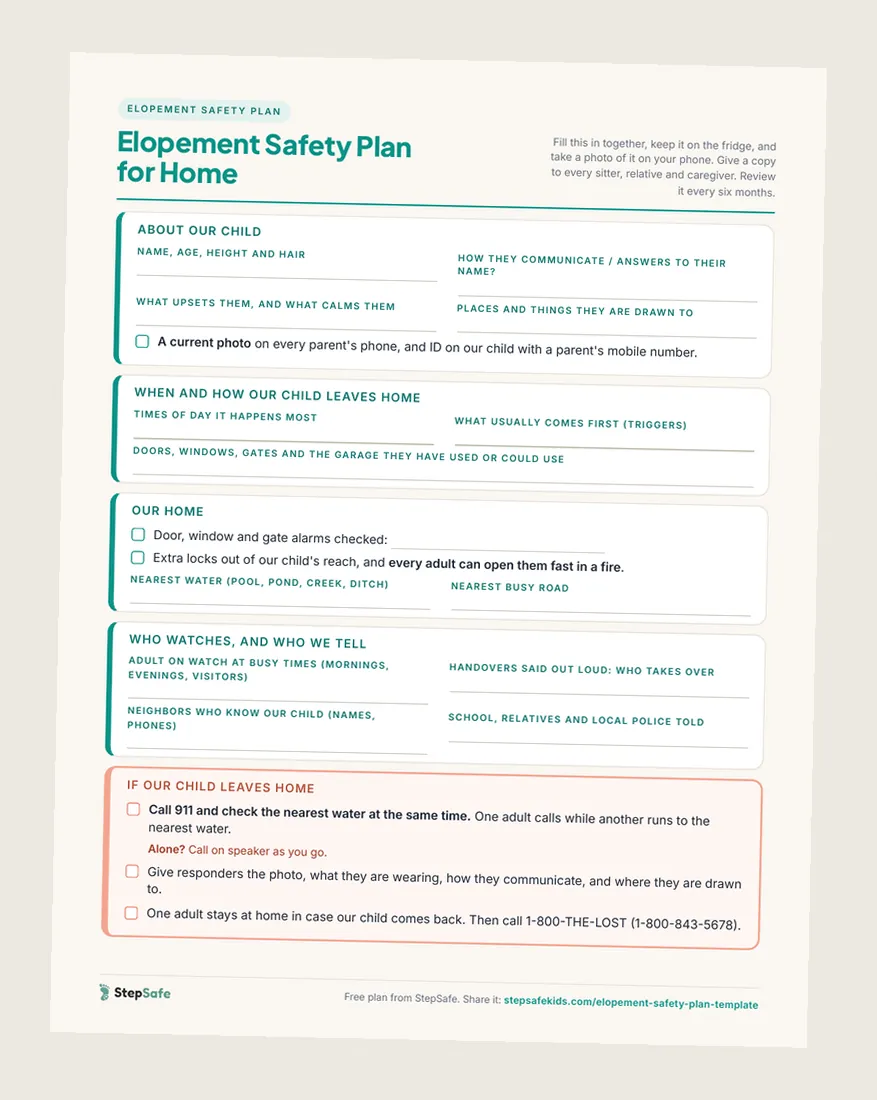
Preview of the free elopement safety plan for home, with spaces to fill in about our child, when and how our child leaves home, our home, and who watches and who we tell, and a box for if our child leaves home, starting with calling 911 and checking the nearest water at the same time.
The fill-in form as a one page PDF. Fill it in together, keep it on the fridge, take a photo of it on your phone, and review it every six months.

What this page is not

It is a planning guide based on guidance from the organisations linked below. It is not medical or legal advice, and it does not replace instructions from police, emergency services or your child’s care team, which always come first. Check any lock or alarm against your local fire safety rules.

What we make

StepSafe is a GPS tracker for kids who wander. It is a location-awareness aid that does not replace supervision, locks or the plan above. Our free Child Safety Toolkit and our guides to the outing safety plan and the school safety plan cover the rest of the week.

Looking for the tracker itself? See the StepSafe shop

Common questions

What is an elopement safety plan?

A short written plan for a child who leaves a safe place without telling anyone. It records how and when your child leaves, what has been done to secure the home, who watches and who has been told, the nearest water and roads, and the steps every adult takes first if your child goes missing.

What should a home elopement safety plan include?

A profile of your child with a current photo and how they communicate, the times and triggers when they leave, the doors, windows and gates they use, alarms and locks, who is on watch at busy times, the neighbors and relatives who know your child, the nearest water and roads, and the emergency steps.

Is there a free elopement safety plan template?

Yes. The template on this page is free to print, with no email needed. It fits on one page so it can live on the fridge, and there is a PDF version to give to sitters, relatives and caregivers.

What do I do first if my child elopes from home?

Call 911 and check the nearest water at the same time. One adult calls while another runs to the nearest water. If you are alone, call on speaker as you go. Then give responders a current photo and tell them how your child communicates.

How often should I update an elopement safety plan?

Whenever something changes, such as a new home, a new school, a new way your child gets out, or a new caregiver, and at least every six months. Update the photo more often, because children change quickly.

Free wandering safety resources

Whatever you decide about devices, preparation matters more. Every one of these is free, with no email required.

Sources

  1. Anderson C, Law JK, Daniels A, et al. Occurrence and Family Impact of Elopement in Children With Autism Spectrum Disorders. Pediatrics. 2012;130(5):870-877
  2. National Autism Association, About Autism and Wandering
  3. National Center for Missing & Exploited Children, Supporting Children on the Autism Spectrum: Tips for Caregivers (PDF)
  4. National Center for Missing & Exploited Children, Autism and Wandering

Free resources

Comments

Have a question, or something that worked for your family? Share it here. You only need a nickname.

No comments yet. Questions, experiences and tips from other parents are welcome.

Leave a comment

Every comment is read by a person before it appears. Please don't share your child's full name, school or address.

Shown with your comment. A first name or any nickname is fine.

Plain text. Links, emails and phone numbers are not allowed.0 / 2,000

All articles →

Are you a parent creator? Earn 15% when families you refer order. Join the partner program