Skip to content
← All articles

Halloween safety for kids who wander: a plan for trick-or-treating

Halloween can be a wonderful night, and it is also one of the harder nights of the year for a child who wanders or bolts. It is dark, it is busy, front doors stand open, and a costume can make your child look like every other child on the street. None of that means staying home. It means making a few decisions in daylight, so the evening runs on a plan instead of on luck. Here is that plan, with a checklist to print at the end.

Last updated 23 October 2026. Written by StepSafe, which sells a GPS tracker for children who wander, so read the product parts with that in mind.
Illustration of a house at night under a crescent moon inside a soft circle, its porch light on and a small pumpkin by the door, beside a plain pumpkin on a paper card.

Why Halloween raises the risk

Wandering is common. In a large survey published in Pediatrics, 49% of parents of autistic children said their child had tried to elope at least once after age four, and 26% said their child had been missing long enough to cause concern. Of the children who went missing, 65% were in danger of traffic injury and 24% were in danger of drowning.[1]

The National Center for Missing & Exploited Children notes that highly social, high stress and transitional events often trigger elopement, and that crowds can make it easier by blocking a clear line of sight.[2] Halloween is all of those at once:

  • Darkness. Trick-or-treating happens after sunset, when a small child is hard to see from a few houses away, for you and for drivers.
  • Crowds. Groups spill across sidewalks and driveways, and it is easy to lose sight of one small person for a few seconds.
  • Open front doors. Every house is inviting children to the door, and some children will walk straight inside. Your own door is open too.
  • Costumes. A mask, hood or full body suit hides the features you would normally spot from across the street. On a street full of superheroes, yours looks like the others.
  • Noise and sensory overload. Doorbells, recorded screams, fog machines, flashing lights and strangers in masks can overwhelm a child quickly, and running is a common response.
  • Other children running. When children dash between houses, a child who bolts does not stand out. It looks like part of the fun.

Traffic matters too. A study in JAMA Pediatrics of 42 years of US crash data found the risk of a pedestrian death was 43% higher on Halloween evening than on the same evenings a week before and after, and 10 times higher for children aged 4 to 8.[3] That covers all children, not only children who wander, but it is a good reason to keep your route away from busy roads.

Before the night

Most of the safety on Halloween is decided before it gets dark.

  • Practise the route in daylight. Walk it once or twice in the days before, in the costume if your child will wear it. Point out the houses you will visit and where you will turn around. A few photos of the route can help as a picture story. Familiar is calmer.
  • Keep it short. Ten houses your child enjoys beat forty that wear them out. Choose quiet streets with sidewalks, and stay away from busy roads, ponds and pools where you can.
  • Set a meeting spot. Pick one place everyone can see and name, such as your front porch or a particular lamp post. Practise walking to it, and tell every adult in the group.
  • Take a photo that evening. Just before you leave, take a clear, full length photo of your child in the costume, front and back, and one with any mask off. If they go missing, this is the photo responders need, not last month’s school picture.
  • Put ID inside the costume. Write your child’s name and your mobile number on a label or card inside the costume or a pocket, or use an ID bracelet. The CDC recommends keeping identification on a child who wanders.[4] Never put your home address on the outside of a costume, where any stranger can read it.
  • Make the costume easy to see. The American Academy of Pediatrics suggests bright, reflective costumes, reflective tape or glow-in-the-dark details on costumes and treat bags, and hats that do not slide over the eyes. It also suggests face paint rather than a mask.[5] A glow stick necklace and a small flashlight help you keep track at a glance.
  • Decide who watches, at every moment. Write it down: who has your child from the moment you leave, who takes over if that adult needs a break, and who stays home with the door. If the answer is “everyone”, nobody is really watching.

At home: the open front door

If you are handing out candy, your front door opens and closes all evening, usually while your attention is on the people outside. For a child who bolts, that is an open exit for hours.

  • Put a chime or alarm on the door. An inexpensive battery door chime tells you every time it opens. If you already have one, check the batteries that afternoon.
  • Sit outside instead. Put a chair and the candy bowl on the porch or at the end of the driveway, and keep the door closed behind you. Fewer doorbells is a bonus for a child who finds them hard.
  • Add a gate or barrier. A baby gate across the hallway, or a closed inner door, puts a second layer between your child and the street.
  • Give one adult the inside. If your child is staying home, one adult stays with them, not with the door. Or leave a bowl out, turn the porch light off and enjoy a quiet evening in.

During the night

  • One adult, one job. Assign one adult only to your child. That adult does not hand out candy, film, chat or look after the other children. Two children who wander means two adults. Hand over out loud: “You have him now.”
  • Check in often. Agree a rhythm, such as holding hands between houses and a hand on the shoulder at every door. In a group, count heads at every corner.
  • Keep the meeting spot rule. Anyone who gets separated goes to the meeting spot and waits there. Say it before you leave, and again halfway round.
  • Plan for sensory breaks. Bring ear defenders or headphones and a favourite snack or object, and decide in advance where you can step away from the noise: your car, a friend’s porch, or home. A break before your child is overwhelmed works better than one after.
  • Stop early. Ending on a good note after five houses is a success. Agree a simple signal your child can use to say they are done.

If your child goes missing

Do both at once

Call 911 and check the nearest water at the same time. One adult calls while another runs to the nearest water. Alone? Call on speaker as you go.

On a Halloween street, the nearest water may be a neighbour’s pool, a hot tub, a pond or a drainage ditch you have never noticed. The National Autism Association’s advice for any missing autistic child is to search nearby water first.[6] NCMEC reports that of at least 98 children and young adults on the autism spectrum recovered deceased after going missing in 2025, 88% drowned.[2] Our guide to water safety and wandering explains why water always comes first.

Then:

  1. Give responders the photo you took that evening, and describe the costume, including what your child is wearing underneath. Overwhelmed children often pull off masks and costumes.
  2. Tell them your child’s diagnosis and how they communicate: whether they speak, whether they answer to their name, and what frightens or calms them. Sirens, flashlights and shouting can make some children hide.
  3. Tell them your route, the meeting spot and the places your child loves, so searchers can check them.
  4. Keep one adult at home and one at the meeting spot, in case your child comes back.

Our free first 10 minutes checklist sets out the same order on one page, ready for the fridge.

Simpler ways to do Halloween

Door to door is not the only way to celebrate, and choosing an easier version is not missing out.

  • Trunk-or-treat. Many schools, places of worship and community centres host events where children collect treats from decorated car trunks in one parking lot. They are usually earlier, smaller and contained. Still note where the exits and roads are.
  • Sensory-friendly events. Some libraries, museums, recreation centres and autism groups hold quieter Halloween events, often in daylight, with less noise and smaller crowds. Ask locally, as they vary from town to town.
  • A few friends’ houses. Arrange a short route of three or four homes where the families know your child and are expecting you. Your child still gets the doorbell and the candy, with people who understand.
  • Halloween at home. Some children love handing out candy more than collecting it. Others prefer a costume, a film and a bowl of treats with the door closed. That counts too.

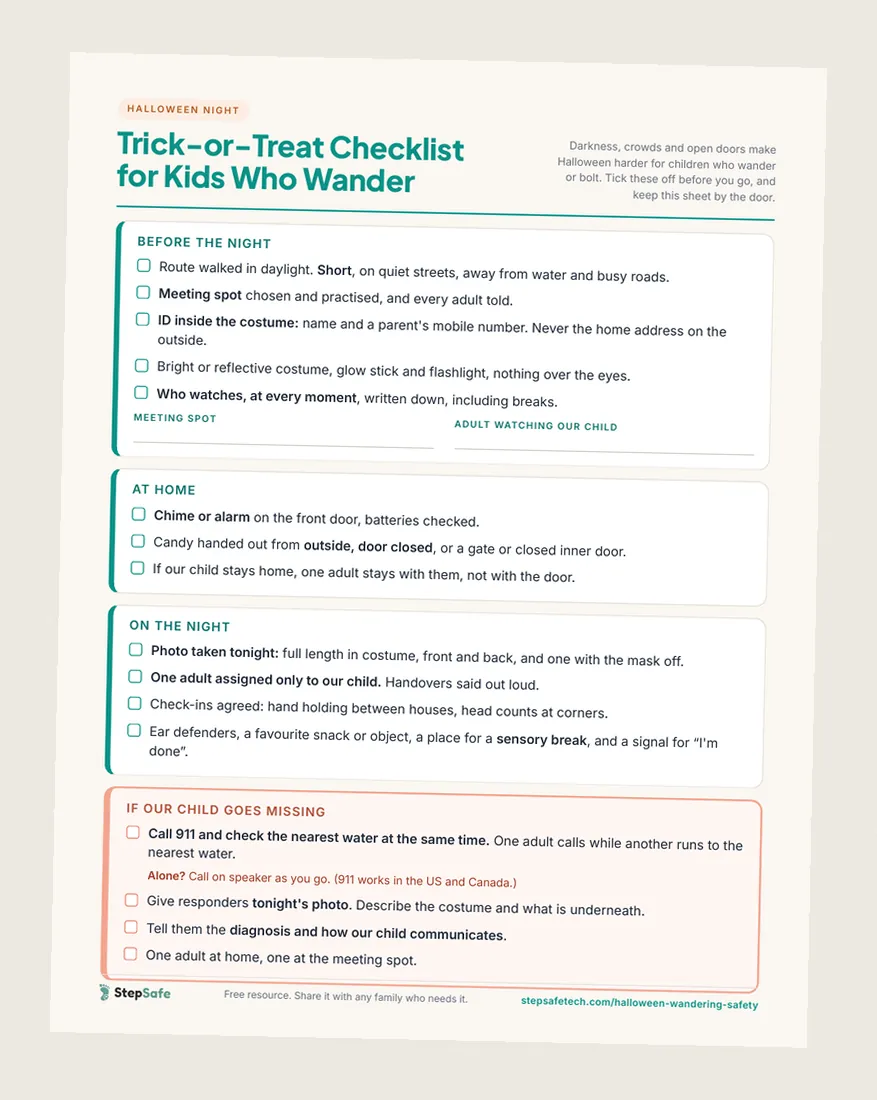
The printable checklist

Or download the one page PDF

Before the night

  • Route walked in daylight, short, on quiet streets away from water and busy roads
  • Meeting spot chosen and practised, and every adult told
  • ID inside the costume: name and my mobile number, no home address on the outside
  • Bright or reflective costume, glow stick and flashlight, nothing over the eyes
  • Who watches our child at every moment written down, including breaks

At home

  • Chime or alarm on the front door, batteries checked
  • Candy handed out from outside with the door closed, or a gate or closed inner door
  • One adult inside with our child if they stay home

On the night

  • Full length photo taken in costume, front and back, and one with the mask off
  • One adult assigned only to our child, with handovers said out loud
  • Check-ins agreed: hand holding between houses, head counts at corners
  • Ear defenders, a favourite snack or object, and a place for a break
  • A signal our child can use to say they are done

If our child goes missing

  • Call 911 and check the nearest water at the same time (alone: call on speaker as you go)
  • Give responders tonight's photo and describe the costume and what is underneath
  • Tell them the diagnosis and how our child communicates
  • One adult at home, one at the meeting spot
Preview of the free Halloween night checklist for kids who wander, with tick boxes grouped into before the night, at home, on the night, and if our child goes missing, starting with calling 911 and checking the nearest water at the same time.
The same checklist as a one page PDF. Print it and keep it by the door on the night.

What this page is not

It is a planning guide based on guidance from the organisations linked below and on what families have told us. It is not medical advice, and it does not replace instructions from police or emergency services, which always come first.

What we make

StepSafe is a GPS tracker for kids who wander. It is a location-awareness aid that does not replace supervision, and on a night like Halloween the plan above matters far more than any device. Devices ship in early 2027. In the meantime, our free Child Safety Toolkit and our guide to making a wandering safety plan cover the rest of the year, and our printable Safety Kit has the planning worksheets in one place.

Common questions

Should my child who wanders go trick-or-treating?

Many children can, with a plan: a short route practised in daylight, one adult assigned only to them, ID inside the costume and a photo taken that evening. If door to door is too much, trunk-or-treat, a sensory-friendly event or a few friends' houses can be just as much fun.

What should I put on my child's Halloween ID?

Your child's name and your mobile number, on a label or card inside the costume or a pocket, or on an ID bracelet. Do not write your home address on the outside of a costume, where any stranger can read it.

What do I do first if my child goes missing on Halloween?

Call 911 and check the nearest water at the same time. One adult calls while another runs to the nearest water. If you are alone, call on speaker as you go. Then give responders the photo you took that evening, and tell them about your child's diagnosis and how they communicate.

How do I stop my child slipping out while I hand out candy?

Put a chime or alarm on the front door, or sit outside with the candy and keep the door closed behind you, or put a gate or a closed inner door between your child and the entrance. If your child stays home, one adult stays with them rather than with the door.

Free wandering safety resources

Whatever you decide about devices, preparation matters more. Every one of these is free, with no email required.

Sources

  1. Anderson C, Law JK, Daniels A, et al. Occurrence and Family Impact of Elopement in Children With Autism Spectrum Disorders. Pediatrics. 2012;130(5):870-877
  2. National Center for Missing & Exploited Children, Autism and Wandering
  3. Staples JA, Yip C, Redelmeier DA. Pedestrian Fatalities Associated With Halloween in the United States. JAMA Pediatrics. 2019;173(1):101-103
  4. CDC, Wandering (Elopement), Child Development
  5. American Academy of Pediatrics, HealthyChildren.org, Halloween Fun and Safety Tips for Kids of All Ages
  6. National Autism Association, Water Safety and Drowning Prevention

Free resources

All articles →
    • Safety planning
    • Autism and wandering
    • Dementia
    • Water safety

    How to make a wandering safety plan

    Seven steps to a written plan for a child, or an adult living with dementia, ending in a printable checklist for the fridge.

    8 min read

    • Autism and wandering
    • Safety planning
    • Water safety

    A practical guide to wandering and elopement

    What the research says, how to prevent it, and exactly what to do in the first five minutes. Water first.

    7 min read

    • Water safety
    • Autism and wandering

    Water safety and wandering

    Why water is the biggest risk when autistic children wander, and the layers of protection that help most, from swim lessons to four-sided pool fences.

    8 min read

Are you a parent creator? Earn 15% on every family you help keep safe. Join the partner program