Skip to content
← All articles

Outing safety plan for a child who elopes (free printable form)

An outing safety plan is one page you fill in before you leave the house: who is watching your child at every moment, a photo of them taken today, a meeting spot, where the nearest water and roads are, and what you will do first if they slip away. Parks, stores, parties and field trips are where many children who elope get away, because the place is new, busy and full of exits. Five minutes with the form below turns a stressful trip into one that runs on a plan. It is free to print.

Last updated 10 November 2026. By Ashwin Chunchu, founder of StepSafe, which sells a GPS tracker for children who wander, so read the product parts with that in mind.

Illustration of a clipboard holding a plan with three of five boxes ticked, beside an instant photo of a child and a location pin next to a pond, on a torn paper card.

Why outings raise the risk of elopement

Elopement is common. In a large survey published in Pediatrics, 49% of parents of autistic children said their child had tried to elope at least once after age four, and 26% said their child had been missing long enough to cause concern. Of the children who went missing, 65% were in danger of traffic injury and 24% were in danger of drowning.[1]

The National Center for Missing & Exploited Children (NCMEC) says elopement can happen in any environment, at any time of day, and from the care of any person. High stress, highly social and transitional events are often triggers, and crowds make it easier because there are fewer secured doors and less clear sight.[2] An outing is usually all of those at once:

  • A new place. Your child does not know the layout, and neither may you. Exits, water and roads are wherever they happen to be.
  • Transitions. Getting out of the car, leaving one exhibit for the next, and leaving at the end are all moments when attention is split.
  • Crowds and noise. A busy store, a party or a field trip group blocks your line of sight for a few seconds at a time.
  • Many adults, no one in charge. When several adults are present, each can assume another is watching.

NCMEC also notes that children on the autism spectrum may head toward water, roads, trains or other places of special interest, and that drowning most often happens within a few hundred feet to half a mile of where the child went missing, and within minutes.[2] That is why the form asks where the nearest water and roads are before you arrive.

Before you go: the five minute outing plan

Most of the safety on an outing is decided at home, before anyone is in the car.

  • Name the adult who watches. Write down who has your child first and who takes over when they need a break. If the answer is “everyone”, nobody is really watching. Hand over out loud: “You have her now.”
  • Take a photo today. A clear, full length photo on your phone just before you leave, showing today’s clothes, shoes and hat. NCMEC recommends having a current photo of your child ready for law enforcement.[3]
  • Write down what they are wearing. Colours and shoes are what searchers look for first. It takes ten words.
  • Put ID on your child. Their name and your mobile number inside a pocket, on a label or on a wristband. Keep your home address off anything a stranger can read.
  • Look at the map. Before you arrive, check where the nearest pond, pool, fountain or creek is, and the nearest busy road, parking lot or railway. NCMEC suggests knowing the water, highways and landmarks near the places your child spends time.[3]
  • Pack for a break. Ear defenders or headphones, a favourite snack or object, and a plan for where you can step away from the noise.

At the destination: the first two minutes

When you arrive, stop for two minutes before your child is let loose. Do it together if you can, so it becomes part of the routine.

  • Find the exits. Doors, gates, gaps in fences and the parking lot. Note which ones your child could reach before you could.
  • Find the water. Confirm what you saw on the map. A decorative pond, fountain or drainage ditch counts.
  • Pick a meeting spot. One place everyone can see and name: a particular bench, a sign, the car. Walk to it with your child and tell every adult in the group.
  • Pick a quiet place. Somewhere you can go before your child is overwhelmed: the car, a quiet corner, a bench away from the crowd.
  • Agree check-ins. Holding hands in crowds and car parks, and a head count at every move from one area to the next.

The National Autism Association advises staying extra vigilant during transitions, parties, vacations, visits and times of noise or commotion.[4] On most outings, the riskiest moments are arriving and leaving, so keep hands held from the car door to the entrance and back.

School field trips and outings with other caregivers

When someone else is taking your child out, the plan matters even more, because they may not know what you know.

  • Ask the school who is assigned to your child. By name, and who takes over at lunch or on the bus. Ask how handovers are done.
  • Ask where they are going. Is there water, a road or a railway nearby? What is the plan for the busiest part of the day?
  • Ask what staff do first if your child leaves. NCMEC suggests making a plan with your child’s school for the event they leave, and notes that wandering can be addressed in your child’s Individualized Education Program (IEP).[3]
  • Hand over a filled-in form. Give the lead adult a copy of the outing plan with the “about our child” section done: how they communicate, whether they answer to their name, what upsets them and what calms them.

The same applies to grandparents, sitters and other families. Our caregiver briefing card covers the things a new adult needs to know in one page, and our school safety plan helps with the conversation at school.

If your child goes missing on an outing

Do both at once

Call 911 and check the nearest water at the same time. One adult calls while another runs to the nearest water. Alone? Call on speaker as you go.

NCMEC’s advice is to call 911 immediately and search the surrounding area, especially bodies of water, because time is of the essence. Once 911 is called, you can also contact NCMEC at 1-800-THE-LOST (1-800-843-5678).[3] The National Autism Association’s rule for any missing person with autism is the same: call 911 and search water first.[4] Our guide to water safety and wandering explains why.

Then:

  1. Give responders the photo you took today and say what your child is wearing.
  2. Tell them how your child communicates. NCMEC notes some children may not speak, may not respond to their name, and may hide from searchers or noise.[2]
  3. Tell them the places on site your child is drawn to: water, trains, vehicles, a favourite shop.
  4. Keep one adult at the meeting spot in case your child comes back.

Our free first 10 minutes checklist sets out the same order on one page.

The free printable outing safety plan form

Or download the one page PDF

Before we go

  • The adult watching our child first, and who takes over, written down
  • Photo of our child taken today, full length, on my phone
  • What our child is wearing today written down: colours, shoes, hat
  • ID on our child: name and a parent's mobile number, no home address on show
  • Nearest water, roads and parking lots checked on the map
  • Ear defenders, a favourite snack or object, and a plan for a break

When we arrive

  • Exits found, including gates and gaps in fences
  • Water confirmed, including fountains and ditches
  • Meeting spot chosen, walked to and told to every adult
  • Quiet place for a break chosen
  • Check-ins agreed: hands held in crowds and car parks, head counts at every move

If our child goes missing

  • Call 911 and check the nearest water at the same time (alone: call on speaker as you go)
  • Give responders today's photo and what our child is wearing
  • Tell them how our child communicates and what they are drawn to
  • One adult stays at the meeting spot
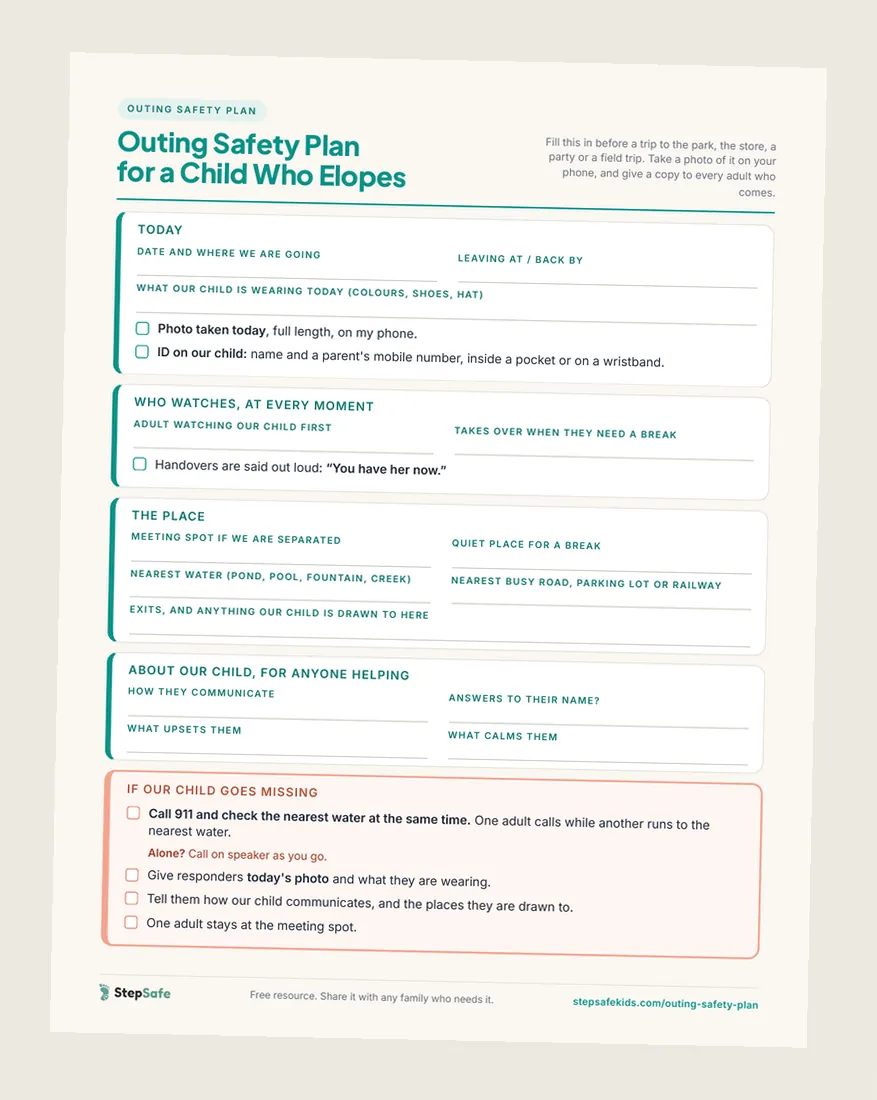
Preview of the free outing safety plan form, with spaces to fill in for today, who watches at every moment, the place, and about our child, and a box for if our child goes missing, starting with calling 911 and checking the nearest water at the same time.
The fill-in form as a one page PDF. Fill it in before you leave, take a photo of it on your phone, and give a copy to every adult who comes.

What this page is not

It is a planning guide based on guidance from the organisations linked below and on what families have told us. It is not medical advice, and it does not replace instructions from police, emergency services or your child’s school, which always come first.

What we make

StepSafe is a GPS tracker for kids who wander. It is a location-awareness aid that does not replace supervision, and on an outing the plan above matters more than any device. Our free Child Safety Toolkit and our guide to making a wandering safety plan cover the rest of the week.

Switching from another tracker? Stuck in a contract? We'll cover the overlap. See the switching offer

Common questions

What should an outing safety plan for a child who elopes include?

Who is watching your child at every moment and who takes over, a photo taken that day, what they are wearing, ID with a parent's phone number, a meeting spot, the nearest water, roads and exits, a quiet place for a break, how your child communicates, and what to do first if they go missing.

Why take a photo of my child before an outing?

If your child goes missing, responders need to know what they look like today: their clothes, shoes, hat and hair. A photo taken that morning on your phone is far more useful than a school picture from months ago.

How do I plan a school field trip for a child who elopes?

Ask the school who will be assigned to your child, how handovers work, where the group will be and whether there is water nearby, and what the staff will do first if your child leaves. Wandering can be addressed in your child's IEP. Give the lead adult a filled-in copy of the outing plan.

What do I do first if my child goes missing on an outing?

Call 911 and check the nearest water at the same time. One adult calls while another runs to the nearest water. If you are alone, call on speaker as you go. Then give responders today's photo and tell them how your child communicates.

Free wandering safety resources

Whatever you decide about devices, preparation matters more. Every one of these is free, with no email required.

Sources

  1. Anderson C, Law JK, Daniels A, et al. Occurrence and Family Impact of Elopement in Children With Autism Spectrum Disorders. Pediatrics. 2012;130(5):870-877
  2. National Center for Missing & Exploited Children, Autism and Wandering
  3. National Center for Missing & Exploited Children, Supporting Children on the Autism Spectrum: Tips for Caregivers (PDF)
  4. National Autism Association, About Autism and Wandering
  5. National Autism Association, Water Safety and Drowning Prevention

Free resources

Comments

Have a question, or something that worked for your family? Share it here. You only need a nickname.

No comments yet. Questions, experiences and tips from other parents are welcome.

Leave a comment

Every comment is read by a person before it appears. Please don't share your child's full name, school or address.

Shown with your comment. A first name or any nickname is fine.

Plain text. Links, emails and phone numbers are not allowed.0 / 2,000

All articles →

Are you a parent creator? Earn 15% when families you refer order. Join the partner program