Skip to content
← All articles

Door alarms for autism: how to secure your home when a child wanders

Door alarms for autism are simple devices that sound when a door, window or gate opens, so you know the moment your child heads out. On their own they do not keep a child safe, but together with locks placed out of reach, visual stop signs on the doors, and a plan for what sets off the urge to leave, they make it much harder for your child to leave unnoticed. This guide goes room by room, and keeps one rule throughout: nothing you add should block your own way out in a fire.

Last updated 12 November 2026. By Ashwin Chunchu, founder of StepSafe, which sells a GPS tracker for children who wander, so read the product parts with that in mind.

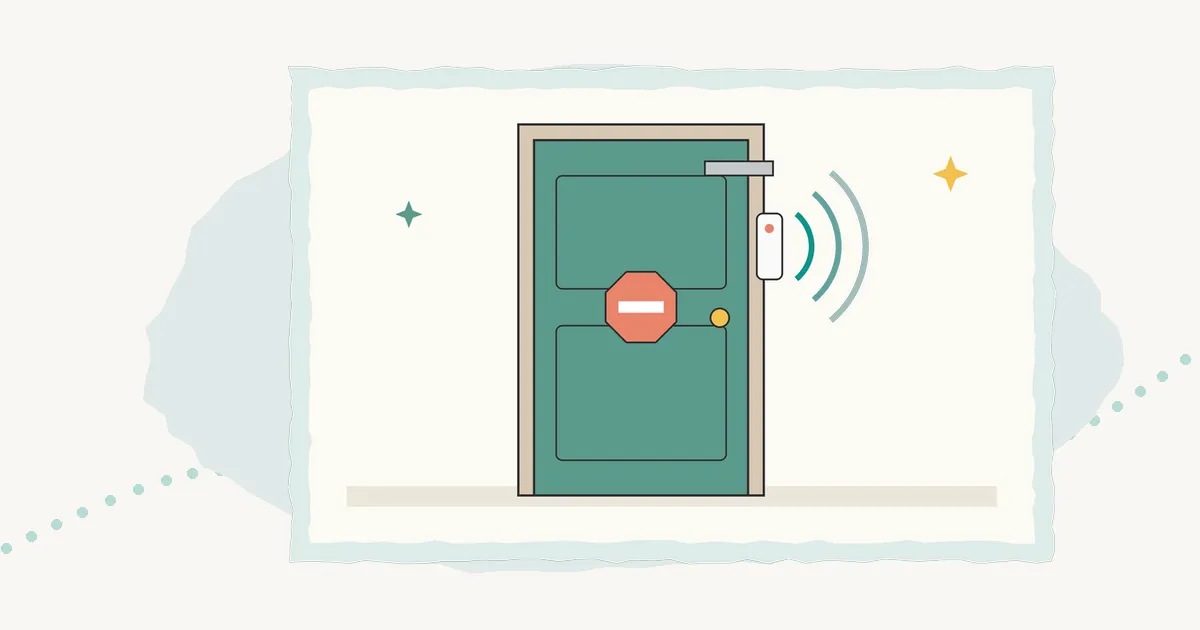
Illustration of a teal front door with a stop sign at child height, a latch near the top, and a small alarm sensor on the frame sending out sound waves, on a torn paper card.

Why door alarms for autism matter

In a large survey published in Pediatrics, 49% of parents of autistic children said their child had tried to elope at least once after age four, and 26% said their child had been missing long enough to cause concern. Of those children, 24% were in danger of drowning and 65% in danger of traffic injury.[1]

Many children leave quietly and quickly, and the National Autism Association notes that more than a third of children who wander can never or rarely tell someone their name, address or phone number.[2] That is why the first step on almost every prevention list is the home itself: securing doors, gates and the garage, and adding simple alarms so an adult knows at once.[2]

An alarm buys you the first few seconds. The National Center for Missing & Exploited Children (NCMEC) says drowning most often happens within a few hundred feet to half a mile of where a child went missing, and within minutes.[6] Hearing the door is what lets you act inside that window.

Types of door alarms for autism, and what each one does

  • Door open alarms and chimes. A small sensor on the door and frame sounds when the two separate. Put one on every outside door, including the door to the garage and any back or side door. A chime that sounds in the room where you sleep matters most at night.
  • Window alarms. The same idea on any window your child can reach and open, especially on the ground floor.
  • Gate alarms. For a yard gate that leads to a street or a neighbour’s yard.
  • Pool and water alarms. The National Autism Association lists gate, pool, window and door alarms together with fencing and self-latching gates as water safety measures.[4]
  • Baby monitors. The National Autism Association suggests simple door or window alarms and baby monitors as part of securing the home.[2] A camera pointed at the main door lets you check without getting up.

When choosing, look for an alarm loud enough to hear from the furthest bedroom, a chime you can tell apart from the doorbell, and batteries you will remember to change. Test every alarm when you change the clocks.

Locks out of reach, with a way out in a fire

An alarm tells you a door opened. A lock or latch placed higher than your child can reach slows them down. Many families add one to each outside door, and a latch on the yard gate.

Before you add any lock, think about fire. Ready.gov advises finding two ways out of every room, making sure windows are not stuck and that security bars can be opened properly, and practising your escape plan twice a year.[5] For a family with a child who wanders, that means:

  • Every adult and older child in the home can open every lock quickly from inside, in the dark.
  • If a lock needs a key, the key lives next to the door, out of your child’s reach but never in another room.
  • Your fire escape plan includes who carries or guides your child out.
  • You teach your child not to hide from firefighters, as Ready.gov advises.[5]

If you are unsure whether a lock is safe for your home, ask your local fire department.

Stop signs and visual prompts on the doors

For many children, a picture works better than a word. The National Autism Association suggests visual aids such as stop signs on doors, windows and pool gates.[4] A bright stop sign at your child’s eye level on every outside door is a reminder every time they reach for the handle.

Pair it with a short social story about the door: we stop at the stop sign, we find a grown-up, we go out together. The National Autism Association also recommends social stories for water safety.[4] Practise it when everyone is calm, not when your child is already at the door.

Know the triggers, and offer a safe space

Alarms deal with the moment of leaving. The National Autism Association also suggests working on why your child leaves: identifying triggers, teaching safety, and offering a safe space as an alternative, such as a small tent or a quiet nook.[2]

  • Write down every attempt. The time, the door, what was happening just before. Over time, patterns can show up.
  • Plan for busy times. NAA advises extra vigilance during transitions, parties, vacations, visits and times of noise or commotion.[2] Those are the days to check every alarm is on.
  • Make the safe space better than the door. Somewhere quiet and familiar, with the things that calm your child, that they are always allowed to go to.

The free safety box from the National Autism Association

The National Autism Association has offered a free Big Red Safety Box to families of children who wander. It includes two wireless door or window alarms, adhesive stop sign prompts for doors and windows, an ID bracelet or shoe tag, a window cling and a child ID kit.[3] It is given out when in stock, so check the page for whether it is available now.

The same page reminds families to keep close supervision whatever tools they use.[3]

When the alarm goes off

If your child is gone, do both at once

Call 911 and check the nearest water at the same time. One adult calls while another runs to the nearest water. Alone? Call on speaker as you go.

The National Autism Association’s rule for a missing person with autism is to call 911 and search water first.[2] NCMEC reports that in 2025, at least 104 children and young adults with autism who went missing were found deceased, and 87% of them drowned.[6] Our free first 10 minutes checklist sets out what to do next, and our guide to water safety and wandering explains why water comes first.

Tell your neighbours too. Our neighbour letter lets them know your child may wander and what to do if they see them alone.

Home security checklist for a child who wanders

Doors and windows

  • An alarm or chime on every outside door, including garage and side doors
  • Alarms on windows our child can reach and open
  • A lock or latch on each outside door, placed out of our child's reach
  • Every adult can open every lock quickly from inside, in the dark
  • Stop sign prompts at our child's eye level on outside doors

Yard and water

  • Yard gates latched, with a gate alarm if they lead to a street
  • Fencing and a self-latching gate around any pool, with a pool alarm
  • Nearest water outside our home found and written down

Every week

  • Alarms tested and batteries checked
  • Fire escape plan includes who brings our child out
  • Wandering attempts written down: time, door, what happened before
  • Safe space ready and stocked with what calms our child

What this page is not

It is a planning guide based on guidance from the organisations linked below. It is not medical advice and not a fire safety inspection. Instructions from your local fire department, police and your child’s care team always come first.

What we make

StepSafe is a GPS tracker for kids who wander. It is a location-awareness aid that does not replace supervision or the steps on this page. Our free Child Safety Toolkit and our guide to making a wandering safety plan cover the rest of the plan.

Switching from another tracker? Stuck in a contract? We'll cover the overlap. See the switching offer

Common questions

What kind of door alarm is best for a child with autism who wanders?

Most families start with a simple alarm or chime on every outside door that sounds when the door opens, so an adult hears it from anywhere in the house. Add window alarms on reachable windows, and gate or pool alarms if there is water at home. The best setup is the one that covers every way out and that you will actually leave switched on.

Are door alarms enough on their own?

No. An alarm tells you a door has opened; it does not stop your child or tell you where they went. The National Autism Association says to keep close supervision whatever tools you use, and pairs alarms with fencing, visual prompts, teaching safety skills and an emergency plan.

Can I put extra locks on doors for a child who wanders?

Many families add a lock or latch placed higher than the child can reach. Every adult in the home must be able to open it quickly from inside. Ready.gov advises two ways out of every room, windows that are not stuck, and security bars that can be opened properly, so a lock should never block the way out in a fire.

Where can I get a free door alarm for my autistic child?

The National Autism Association has offered a free Big Red Safety Box to eligible families, including two wireless door or window alarms, stop sign prompts and ID items. It is given out when in stock, so check the page for current availability.

What do I do if the door alarm goes off and my child is gone?

Call 911 and check the nearest water at the same time. One adult calls while another runs to the nearest water. If you are alone, call on speaker as you go.

Free wandering safety resources

Whatever you decide about devices, preparation matters more. Every one of these is free, with no email required.

Sources

  1. Anderson C, Law JK, Daniels A, et al. Occurrence and Family Impact of Elopement in Children With Autism Spectrum Disorders. Pediatrics. 2012;130(5):870-877
  2. National Autism Association, About Autism and Wandering
  3. National Autism Association, Big Red Safety Box
  4. National Autism Association, Water Safety and Drowning Prevention
  5. Ready.gov, Home Fires
  6. National Center for Missing & Exploited Children, Autism and Wandering

Free resources

Comments

Have a question, or something that worked for your family? Share it here. You only need a nickname.

No comments yet. Questions, experiences and tips from other parents are welcome.

Leave a comment

Every comment is read by a person before it appears. Please don't share your child's full name, school or address.

Shown with your comment. A first name or any nickname is fine.

Plain text. Links, emails and phone numbers are not allowed.0 / 2,000

All articles →

Are you a parent creator? Earn 15% when families you refer order. Join the partner program