
- Water safety
- Autism and wandering
Water safety and wandering
Why water is the biggest risk when autistic children wander, and the layers of protection that help most, from swim lessons to four-sided pool fences.
8 min read
Elopement is when a child leaves a safe place or a responsible adult, and it is common. In a study of 1,218 children with autism, 49% had attempted to elope after the age of four. When a child is not found in time, the cause of death is usually drowning. Both of those facts point at the same thing: plan around water first.
Last updated 20 September 2026. Written by StepSafe, which sells a GPS tracker for children who wander, so read the product parts with that in mind.
The most cited figure comes from Anderson and colleagues, published in Pediatrics in 2012. Of 1,218 children with an autism spectrum disorder, 49% had attempted to elope at least once after age four,[1] a rate close to four times higher than their siblings without autism.[2] Of the children who eloped, roughly one in four were missing long enough to cause real concern.[1],[3]
The CDC puts it the same way: about half of children with autism wander, and of those, one in four go missing long enough to cause serious concern.[3] The CDC also notes that wandering has its own code in medical records, Z91.83,[3] which is worth asking your paediatrician to add.
Children wander for ordinary reasons. They like running. They are heading somewhere specific, often water. They are leaving something stressful, such as noise or a crowd.[3] None of these are failures of parenting, and the research is clear that elopement is a feature of the condition rather than a discipline problem.
The National Autism Association collected 808 wandering cases in the United States between 2011 and 2016 involving people with autism who went missing and were gone long enough to require police or media involvement. Of those, 139 were fatal.[2]
| Cause | Cases | Share |
|---|---|---|
| Drowning | 98 | 71% |
| Struck by a vehicle | 25 | 18% |
| Struck by a train | 6 | 4% |
| Hyperthermia or hypothermia | 4 | 3% |
| Other trauma | 4 | 3% |
| Fall | 2 | 1% |
Two numbers in that table should change what you do. Water causes more than twice as many deaths as every other cause combined, 98 of 139.[2] And roads are second, a long way behind water but well ahead of everything else.
Age matters too. Children under five faced the highest lethal risk, with 26 of 45 cases in that age group ending in death, about 58%, while children aged five to nine accounted for the largest raw number of deaths, 62.[2]
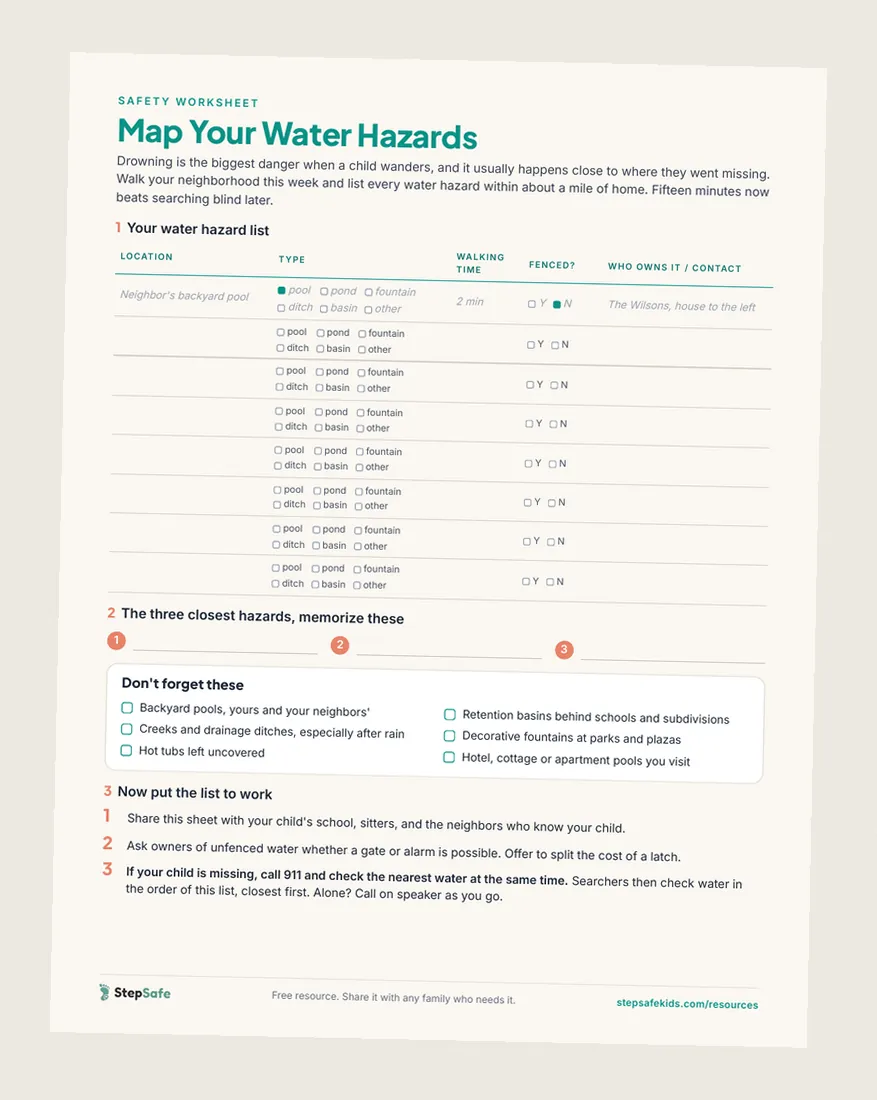
1. Map the water. Every pool, pond, fountain, ditch, retention basin and creek within about a mile of home. Write down how long each takes to walk to, whether it is fenced, and who owns it. This takes one afternoon and it is the single highest value thing on this list. We have a printable worksheet for it.
2. Swim lessons, adapted. Learning to float and get to an edge changes a drowning into a frightening afternoon. Several parents have told us the same thing: group classes did not work at first, one to one lessons did, and group classes worked later once their child was comfortable in the water.
3. Secure the exits. Door and window alarms, including the inexpensive battery kind, plus locks placed where a young child cannot reach. Fencing where it is affordable, and pool fencing before garden fencing. The point is not to make escape impossible. It is to make it noisy. The CDC recommends fences and locks for the same reason.[3]
4. Tell the neighbours. Not the whole street. The four or five households nearest you who would recognise your child. Give them a photo, your phone number and one instruction: if you see them alone, call this number. We have a letter template for this.
5. Tell the police before you need them. Many forces will record a child as being at risk of wandering, with a photo and details of where they are drawn to. Doing this in advance saves the first ten minutes of a search being spent explaining your child to a stranger. Ask your local force what they hold and how to add to it. Keeping first responders informed is also on the CDC’s list.[3]
6. Write the plan down. Who searches where, who calls, who stays home, and which water gets checked first. In an emergency nobody invents a good plan. They execute whatever plan already exists. Ours is a one page checklist for the fridge.
7. Do the same for school. A plan at home does nothing during the school day. A written elopement plan attached to an IEP or 504 outlives a change of teacher.
If your child is missing now, stop reading and do this.
A child who does not respond to their name will not answer searchers calling it. Tell responders that, because it changes a search from calling out to looking.
Near the end of the list, not at the top. A tracker does nothing to stop a child leaving, cannot swim, and is useless if it is sitting on a kitchen counter. Door alarms, fencing, swim lessons and a written plan all prevent. A tracker only shortens the search after prevention has already failed.
Shortening the search is still worth a great deal, because drowning deaths turn on minutes. But a family choosing between swim lessons and a tracker should buy the swim lessons.
If you are weighing devices, the things that actually differentiate them are whether the connection is cellular or Bluetooth, what it costs over five years rather than up front, and whether it can record audio. We compare the main options, including where we come off worse, in AngelSense alternatives, compared honestly.
What this page is not
It is a summary of published research and of what parents have told us, not medical or safety advice for your specific child. The figures come from United States data and from a 2012 study, and they describe groups rather than individuals.
If your child elopes, the people worth talking to are your paediatrician, your child’s school team and your local police, all of whom can act on specifics we cannot see.
What we make
We make a clip-on cellular GPS tracker for children who wander, with live location, safe zone alerts and a permanently disabled microphone. It is one item on the list above, not a substitute for the rest of it.
Everything we link to on this page is free and needs no purchase. See all the free resources.
Why water is the biggest risk when autistic children wander, and the layers of protection that help most, from swim lessons to four-sided pool fences.
8 min read
Seven steps to a written plan for a child, or an adult living with dementia, ending in a printable checklist for the fridge.
8 min read
AirTags, kids' smartwatches, dedicated trackers and police programs compared honestly, with ten questions to ask before you buy anything.
9 min read