
- Buying guides
- Autism and wandering
Choosing a GPS tracker for an autistic child
AirTags, kids' smartwatches, dedicated trackers and police programs compared honestly, with ten questions to ask before you buy anything.
9 min read

Short answer: you can attach one, but it is the wrong tool for wandering, and the reasons are technical rather than a matter of opinion. Here is what it actually does, with sources.
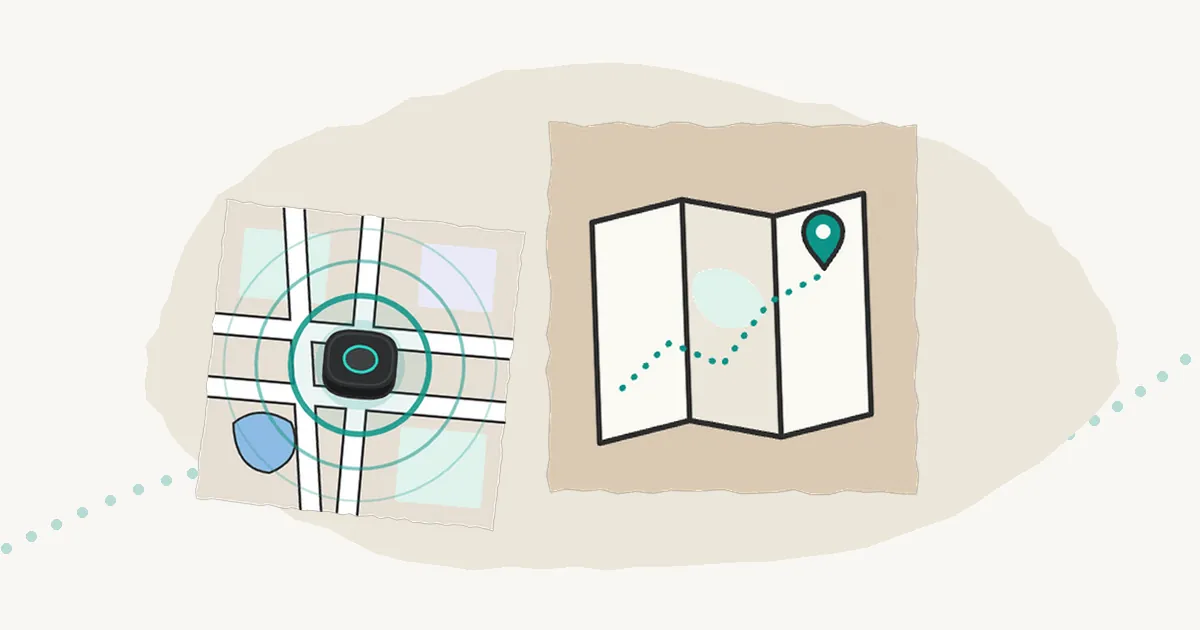
An AirTag contains no GPS receiver and no cellular radio. It never works out where it is. It is found when some other Apple device happens to pass close enough to hear it over Bluetooth, and that device reports its own location. Apple describes the Find My network as “a crowdsourced network of over a billion Apple devices that use Bluetooth technology to detect the location of an accessory or device, and report their approximate location back to the owner.”
Two words in Apple’s own sentence matter for a wandering child: crowdsourced and approximate. There is no guaranteed update schedule, because an update only happens when a stranger’s device wanders past. Apple documents that when the network is not currently detecting an item, the app shows a last known location for up to seven days, and after that displays “No location found.”
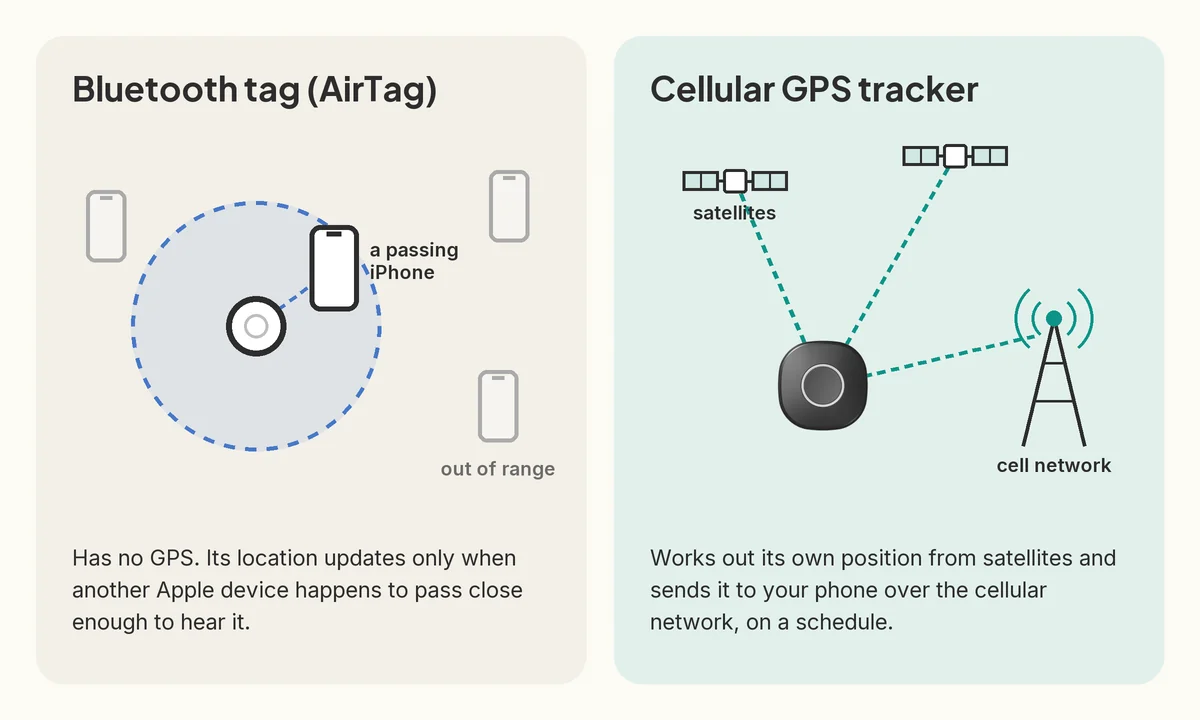
The close-range tools people think of as “finding” the tag, playing a sound and Precision Finding, only work once you are already near it. They help you find keys in a sofa. They do not help you work out which direction a child went.
Our reasoning, not a sourced claim: because updates depend on other people’s devices passing by, coverage is best where crowds are and thinnest where they are not. We have not seen published data measuring this in rural areas, so we will not put a number on it.
Apple’s position is consistent across its newsroom and support documentation: “AirTag was designed to help people locate their personal belongings, not to track people or another person’s property,” and its support pages state these devices “should not be used to track people.”
An important qualification, because this gets exaggerated online: Apple has never published a statement about a parent tracking their own child, and it does not say that doing so is unsafe or prohibited. Anyone telling you Apple “warns parents” against this is going further than the source does. The honest reading is narrower: this is not the use case AirTag was built for, and the product reflects that.
This is the part most comparisons miss. After AirTag was misused for stalking, Apple engineered it to be discoverable by the person carrying it. In Apple’s words, “AirTag is designed to be detected by victims.”
Unwanted-tracking notifications fire on iPhone and iPad, and since May 2024 on Android 6.0 and later, under a specification Apple and Google published jointly. So an AirTag travelling with your child can notify a teacher, a bus driver, a stranger on a train, or a person who has taken them, regardless of which phone that person carries.
A separated tracker also announces itself out loud. Apple: “When moved, any AirTag separated for a period of time from its owner makes a sound to notify those nearby.” The IETF specification that governs these accessories makes the timing deliberately unpredictable: after a random interval between 8 and 24 hours in the separated state, the accessory must listen for motion and play a sound when it detects it. That 8-to-24-hour figure comes from the specification, not from Apple, and it is not something a parent can configure.
The mechanism is worth sitting with. The alert is armed by separation from the owner. It stays quiet while you and your child are together, and arms itself in precisely the situation the tracker was bought for.
Someone who gets an unwanted-tracking alert on a compatible phone can play a sound on the tracker, use Precision Finding to walk to it, and tap through to instructions for disabling it. Removing an AirTag’s battery takes a twist of the cover and no password, only physical possession of the tag.
Two corrections to claims we found circulating while researching this: disabling a tag is not necessarily permanent, and it is not true that literally anyone can do it. The person needs a compatible phone with Bluetooth, Location Services, and tracking notifications switched on.
Put plainly, and this is our conclusion rather than a quote from anyone: a device that cannot locate itself, has no promised update interval, announces its presence on a schedule you cannot control, and can be located and switched off by whoever your child ends up with, is solving a different problem from the one a wandering family has.
That is not a knock on AirTag. It is very good at what it was built for. Keys do not run toward a pond.
Whatever you end up buying, ours or anyone else’s, these are the questions worth asking:
StepSafe is our answer to those questions, and you can see the pricing or read how it works. If you buy something else, that is genuinely fine. Use the list above on us too.
If you are weighing an AirTag against something else, these go further than this page does:
Our own device, the StepSafe SS-01, is a small clip-on tracker with its own GPS and cellular connection and alerts when your child leaves a safe zone. It is on pre-order now and ships in early 2027 to the United States and Canada. See the SS-01 in our shop or browse everything we sell.
Can I use an AirTag to track my child?
You can put one in a backpack or jacket and it will show up in Find My, but it is not a live tracker. It has no GPS or cellular connection, its location only updates when another Apple device passes close by, and it is designed to alert people that it is travelling with them. It is fine for finding a bag. For a child who wanders, a device that works out its own location and alerts you when they leave a safe area is the better tool.
Does an AirTag have GPS?
No. An AirTag has no GPS receiver and no cellular radio, so it never works out where it is. It is found when some other Apple device happens to pass close enough to detect it over Bluetooth and reports that device's own location. Apple describes the Find My network as a crowdsourced network of Apple devices that report an accessory's approximate location back to its owner.
Does Apple say you should not put an AirTag on a child?
Apple has never published guidance specifically about a parent tracking their own child, and it does not say that doing so is unsafe or prohibited. What Apple does say is that AirTag was designed to help people locate personal belongings, not to track people, and that its support documentation states these devices should not be used to track people.
Will an AirTag on my child start beeping?
It can. A tracker that has been separated from its owner for a period of time will play a sound when it is moved. Under the IETF specification that governs these accessories, the separated-state timeout is a random value between 8 and 24 hours, so the timing is deliberately unpredictable and cannot be set by the parent.
Can someone else find out my child is carrying an AirTag?
Yes. Unwanted-tracking alerts fire on iPhone and iPad, and since May 2024 on Android 6.0 and later under a joint Apple and Google specification. Someone who receives that alert on a compatible phone can play a sound on the tracker, walk to it using Precision Finding, and follow on-screen instructions to disable it.
What should I look for instead?
For a child who wanders, the questions that matter are whether the device works out its own position rather than depending on nearby phones, whether it reports on its own over a cellular connection, whether it can alert you when your child leaves a safe area, and whether it is built to stay on a child rather than to be discovered and switched off.
Is it legal to put an AirTag on your child?
We are not lawyers, and the answer depends on where you live. Apple says using these products to track people without their consent is a crime in many countries and regions. A parent keeping track of their own young child is a different situation from tracking another adult, but laws vary by state and province, and in separated families a custody or parenting order can matter. If another parent or an older child is involved, ask a family lawyer where you live.
How far away can you track an AirTag?
There is no fixed range. Up close, your own iPhone can find it over Bluetooth, and Precision Finding can point you to it once you are nearby. Beyond that, an AirTag is only located when someone else’s Apple device passes close enough to detect it. That can happen anywhere in the world, or not at all for hours in a quiet place, which is why it is not a reliable way to follow a child who is on the move.
Does the new AirTag have GPS?
No. Apple released a new AirTag in January 2026 with a longer Precision Finding range, a Bluetooth chip that extends how far away it can be located, and a louder speaker. Like the original, it has no GPS receiver and no cellular connection, so it still depends on nearby Apple devices to report where it is.
Can I stop my child’s AirTag from alerting other people?
Not for strangers. The unwanted-tracking alerts exist to protect people from being followed, and a parent cannot switch them off for everyone nearby. If your child has their own Apple Account, Apple says sharing the AirTag with them through Find My turns off tracking notifications for the people it is shared with. That stops the alert on your child’s own device only.
Whatever tracker you choose, preparation matters more. Every one of these is free, with no email required.
Verified July 25, 2026. Apple product behaviour changes over time; if you find something here that is out of date, email support@stepsafetech.com and we will correct it.
AirTags, kids' smartwatches, dedicated trackers and police programs compared honestly, with ten questions to ask before you buy anything.
9 min read
AngelSense, Jiobit, AirTag and StepSafe on price, privacy and what each is for, including where we come off worse.
6 min read
What Ontario's published rules say about GPS trackers and technology, with links to the official pages.
5 min read